Heavy diesel fuelled vehicles vehicles in urban areas is a serious environmental problem. Urban transit is a case in point.
Now, electric buses are coming. Let us hope this Proterra EcoRide bus will perform and start replacing diesel powered monsters.
The EcoRide bus can be recharged in 10 minutes while waiting for a new circuit.
Here is an illustration:
Saturday, 28 June 2014
Monday, 17 March 2014
Skattereform som motkonjunkturtiltak
Skriften
på veggen – og en oppskrift
Økonomisk nedtur i vente?
Kina kan
stå overfor en økonomisk stagnasjon. Dette vil få ringvirkninger for
verdensøkonomien som også vil berøre oss.
Europa
sliter med å komme i gang igjen etter finanskrisen. Euroen tar vekk
frihetsgrader i det enkelte lands økonomiske politikk, og ødelegger for
tilpasning via nedskrivning av valutaer. Når finanssektoren klarer å snakke
politikerne rundt slik at de som bør ta tap, ikke tar tap, låser det hele seg.
I Norge ser
vi allerede nedbemanninger og tiltagende utfordringer for våre råvarebaserte
næringer. Fastlandsøkonomien ser mørke skyer på horisonten. Den reduserte
kronekursen har foreløpig dempet problemene for konkurranseutsatte næringer,
men gir ingen varig løsning om bytteforholdet mot utlandet svekkes over tid. Et
Kina på sparebluss vil trolig føre til laver pris på det vi selger og høyere
pris på det vi kjøper. Den sterke reallønnsveksten vi har opplevd de siste 10
år, som har gitt oss et lønnsnivå 60 % høyere enn våre konkurrenter, må i så
fall reverseres. Det er ingen enkel sak. Mange familier, spesielt de med to inntekter
har det godt i Kongeriket. Men økende forskjeller mellom fattige og rike, er en
mare som ikke bare rir Kina og USA – vi ser klare tegn til det samme også her
på berget.
Og nå
står vi foran et lønnsoppgjør som uansett utfall vil forverre dette bildet,
fordi selv et beskjedent oppgjør vil være høyere enn hos våre konkurrenter.
Skriften
på veggen: store problemer i den store verden, og nye utfordringer for Norge,
med svekket bytteforhold mot utlandet og den kommende eldrebølgen. Økninger i
overføringer fra staten ligger i kortene.
Hvordan møte denne situasjonen?
Det
første vi må gjøre er å løfte inntekts gulvet for dem som er nederst i inntekts stigen
uten å øke deres nominelle lønninger.
Hvordan gjør vi det? Ganske enkelt. Ved gradvis å fjerne alle skattefradrag, inklusive rentefradraget, og erstatte dem med et enkelt fradragsbeløp, for eksempelets skyld på 200,000 kroner. Hvilket betyr at Inntekter opp til 200.000 kr – uansett hvor inntektene kommer fra – er skattefrie. Incentivet til å eie enda flere kvadratmetere i hytter og hus blir mindre og presset på eiendomsprisene dempes. Ungdom kommer lettere inn i boligmarkedet.
All
personlig inntekt over fradragsbeløpet på 200.000 kroner ilegges, la oss si, 25
% skatt. Dette vil trolig føre til mindre press på NAV for en rekke ytelser til
dem som i dag ikke har nok å rutte med. Så selv om 25 % skatt skulle gi mindre
proveny, vil redusere utbetalinger over NAV trolig føre til at staten samlet
sett ikke kommer så mye dårligere ut rent økonomisk her. I tillegg kommer
gevinsten for samfunnet at det blir færre ”nav-ere”, som trolig også er til
glede for dem selv. Nullskatteytere blir en annen gruppe i denne modellen,
nemlig de med samlet inntekt under 200.000 kr. Alle andre må betale en flat
skatt på 25 % på personlig inntekt over 200.000 kr.
Neste
trekk er å fjerne formueskatten. Tapet her erstattes av en reformert
eiendomsskatt. Kapitalen vi har overinvestert i eiendom, er en form for konsum.
En
revidert eiendomsskatt bør ta utgangspunkt i at beskatningen tar utgangspunkt i
prisen ved kjøpstidspunktet. Skatten beregnes for hele arealet minus 50 m2, som
vil fungere som et ”minstefradrag”. Det resterende areal ganges med
kvadratmeterprisen. Dette beskattes med en avtalt prosentsats. For eiendommer som er fredet og av
kulturhistorisk interesse vil man ha spesielle unntak, der vedlikeholdsansvaret
og hensynet til kulturarven veier tungt.
Videre reduserer vi selskapsskatten, kapitalskatten og skatt på utbytte til 25 %. Dermed blir alle skattene nøytrale, noe som vil redusere skattetilpasninger. Dette vil bety at all overføring til personlig skatteyter over 200,000 kroner beskattes med 25 %. Hvis man tar ut 10 millioner i inntekt og utbytte fra bedriften, og ikke noe i lønn, betaler man 25 % skatt av 9 800 000 kroner.
Som
incentiv for å lage sunn mat i hjemmene, fjerner vi MVA på ubearbeidet mat, som
landbruksprodukter og fisk. Det blir billigere å lage sunn mat hjemme.
Problemet med fedme reduseres samtidig som kostnadsnivået for dem nederst på inntektstigen faller. Tilværelsen for kyst- og landbruksnæringen blir enklere,
noe som vil stimulere til fortsatt bosetning i distriktene. Den enkelte fisker
og bonde kan fritt selge sine varer til oss konsumenter, uten å skulle holde
orden på et momsregnskap.
Til sist,
klimatrusselen må vi ta på alvor. Det betyr at vi alle betaler for våre
utslipp. Det kan gjøres ved at alle varer og tjenester belastes med en avgift
utover MVA avhengig av utslippene som ligger bak framstillingen av det aktuelle
produktet.
Hensikten
er at hver enkelt av oss vil stå fritt til å være økonomisk ”uansvarlig”, men
må betale en rimelig avgift for dette. I sum vil den skissen som her er streket
opp, gi incentiver til mer arbeid, mindre ”naving”, mindre overdrevne og
samfunnsmessige ulønnsomme investeringer i fast eiendom, en jevnere fordeling
av inntektene og et renere miljø.
Saturday, 11 January 2014
Trenger vi nytenking om skatt, overføringer og sosial rettferdighet?
Vi bør kanskje tenke på effektive motkonjunkturforslag nå når økonomien tar seg en hvilepause eller kanskje en nedtur. Dette kan jo bli forsterket hvis oljeprisene faller. Dette vil kunne utløse flere bomber. Den ene at et prisfall i eiendom vil redusere husholdningenes egenkapital og eksponere vår allerede høye gjeldsgrad. Forbruket, som er på et svært høyt nivå vil falle, med raskt økende arbeidsledighet som resultat. En redusert oljepris vil dessuten føre til oppbremsing av offshore investeringene, med følger for en rekke verdikjeder.
Økonomiske sykluser må forventes. I Norge har vi være dyktige og heldige hittil og har ungått de økonomiske drama som har rammet ellers.
Men - kunne dette være en god tid for å tenke nytt istedet for å flikke på det gamle?
OK, la oss se:
- Vi fjerner alle nåværende skattefradrag for personlige skatteytere, inklusive renter.
- Hver skatteyter får istedet et minstefradrag på 200,000 kroner.
- All personlig inntekt over 200,000 kroner beskattes med 25 %.
- Utbytte blir beskattet med 25 %.
- Toppskatten fjernes.
- Arveavgift fjernes
- Formueskatt fjernes
- Eiendomsskatt bør innføres nasjonalt.
- Skatt på overskudd i næring reduseres til 25 %.
- MVA på ubearbeidet mat fjernes.
- Vi innfører karbonskatt.
Noter:
- Dette blir en dramatisk forenkling. Innføres gradvis over en 5-års periode. Det vil medføre at hver skatteyter får stor frihet til å forvalte sin økonomi etter egne prioriteter. Det vil også si at de som er nederst på inntektsstigen knapt vil betale skatt og føre til store forenklinger innen overføringer fra det offentlige. Inntektstapet vil med andre or kunne kompenseres ved at overføringer blir redusert, og ikke minst at byråkratiet vil kunne forenkles.
- Dette er i stor grad tenkt som et fordelingsgrep. Mange pensjonister og folk med lave inntekter vil få et enklere liv.
- Folk med høy lønn eller mye kapital må skatte på alle intekter over 200,000 kroner og utbytte. Dette betyr at uttak som brukes til "fritt konsum" beskattes med samme prosentsats som MVA. Dette vil stimulere til sparing. I motsatt fall, trenger du en Porsche Carrera må du først ilegges 25 % skatt på uttaket som skal finansiere bilen. Pluss MVA, bilavgift etc. etc.
- Det er viktig å ha like skattesatser for å redusere skatteplanlegging
- Ditto
- Dette er særdeles viktig i landbruket og for eiere av historiske anlegg som det er kostbart å holde vedlike.
- Dette vil styrke egenkapitalen og gjøre bedriftene mer robuste.
- Eiendomskatt er en måte for de som bygger og bor dyrt å bidra til kommunekassa. I UK har de Council Tax som har samme funksjon. Eiendommer som man ikke har valgt å ha, typisk med kukturhistorisk verdi eller fredede bygg bør få rabatt. Hva med null eiendomsskatt på bygg med en alder over 150 år og som har vært i samme familie i samme tid?
- Den faktiske skatten som ilegges kan videre justeres ved hjelp av avskrivningsregler.
- Fedmeepedemien er forårsaket av fabrikkmat med for mye salt, sukker og redusert næringsinnhold. Det er spesielt viktig å stimulere folk med dårlig råd til å spise sunt og billig. Da må man lage maten fra grunnen av. MVA frihet her vil ha stor betydning. Dette vil dessuten fornkle hverdagen for bønder, som nå lettere kan selge direkte til forbruker og derved fjerne fordyrende mellomledd. Mer til bonden - mindre kostnad for forbruker.
- Vi må betale den reelle kostnaden våre forbruksvaner belaster miljøet med. Hvis vi tør ilegge en rettferdig karbonskatt har vi løst provenygapet.
Friday, 26 April 2013
Potential battery revolution
The University of Illinois has recently created a potentially revolutionary breakthrough in battery technology. Interestingly, it does not rely on a new chemistry, at least not initially, but rather on the geometry of the physical battery construction.
By designing a nano size porous structure with a precisely dimensioned metal lattice separating the pores, they have reduced the travel distance between the anode and cathode chemicals, where the electrolyte as the transfer medium has a much simpler job due to the dramatically shortened transport distance of the electrically charged ions.
The consequence of this is that the battery has a tenfold size reduction per unit of energy density and can be charged 1,000 times faster than today's batteries.
This means it would take the same time to fully recharge an electric vehicle as it would take to refill the fuel tank.
The technology is being commercialized by http://xerionbattery.com/
The pore structure would look something like this:
Your smartphone would now get fully charged in 10 seconds and you car in 5 minutes after driving 1,000 miles on one battery.
Folks, if we can accelerate the production of renewable energy and add a € 50 per ton carbon tax on everything, we may stop at the edge of the precipice or perhaps not get crushed in the fall if we go over. But only if we act fast and on a massive scale!
By designing a nano size porous structure with a precisely dimensioned metal lattice separating the pores, they have reduced the travel distance between the anode and cathode chemicals, where the electrolyte as the transfer medium has a much simpler job due to the dramatically shortened transport distance of the electrically charged ions.
The consequence of this is that the battery has a tenfold size reduction per unit of energy density and can be charged 1,000 times faster than today's batteries.
This means it would take the same time to fully recharge an electric vehicle as it would take to refill the fuel tank.
The technology is being commercialized by http://xerionbattery.com/
The pore structure would look something like this:
Your smartphone would now get fully charged in 10 seconds and you car in 5 minutes after driving 1,000 miles on one battery.
Folks, if we can accelerate the production of renewable energy and add a € 50 per ton carbon tax on everything, we may stop at the edge of the precipice or perhaps not get crushed in the fall if we go over. But only if we act fast and on a massive scale!
Monday, 26 December 2011
Sunday, 4 December 2011
Musings on the Financial Meltdown
The whole mess can be distilled into a surprisingly simple observation, and it is deeply disturbing that this has not understood and acted upon by those that we have elected to represent us.
There is another more sinister explanation - that they have been manipulated into agreeing to abolish the Glass-Steagall Act and allow an unregulated financial free-for-all.
Anyway - here goes: If debt increases faster than value creation value gets destroyed. Simple.
This I seem to remember was understood by us as undergraduate students in 1970!
One cannot escape the suspicion that the financial industry have wilfully constructed a structure where increasingly fancy "products" have been invented where enough fees are paid up front to make it look suspiciously like a ponzi scheme.
Let us take a household as an example. The situation is analogous on a national level.
If we wish to invest and consume in excess of our income, we must borrow. This implies that we use resources in advance of having created the value - hence the value must be created later. This implies risk.
This works if the assets we invest in increase in value, and if our income grows making debt repayment easy.
This is fine on an individual level in a growing economy. If, however, you get systemic debt expansion to finance investment and consumption over extended periods, asset values will expand to levels where new entrants will be unable to fund new investments and the bubble will burst.
The ensuing collapse in asset values will cause an economic contraction, reducing the ability of households to maintain debt repayments and a stable level of consumption. This is what is happening now.
In Norway, also known as "Cloud ptarmigan land", all interest payments are tax deductible for personal tax payers. The state subsidizes the property asset bubble and our mad consumerist frenzy. Our 20 % credit card interest is tax deductible. Amazing!
If we replace the interest tax deduction with a single, simple deduction equivalent to your "dignity income" that will fix it. That gives the individual freedom to determine how to manage their disposable income without artificial stimulants.
Equally important and not well appreciated is the poverty trap created by the state by loading those on the bottom of the income pyramid with too many costs and complexities. This causes economic and psychological anxiety and is a major contributor to the spiralling social and medical costs we are experiencing.
At the macroeconomic level, however, Norway is a shining example of probity and fiscal discipline Hat off for that!!
Governments in the post Reagan - Thatcher era, inspired by monetarists and economic liberalism with blind faith in "free" markets, deregulation and complete freedom for financial institutions to create weird and wonderful financial "products" are in the process of destroying society as we know it.
At a national level in many other countries, politicians have borrowed big time for infrastructure, welfare and "social consumption" Fine in the short term, and a winner if you want to get back in office.
The wanton borrowing frenzy by Greece is probably the most glaring example here.
Low interest rates have been a major contributor.
Getting out of this mess will be tough as hell and will take a long time.
Enough for now.
There is another more sinister explanation - that they have been manipulated into agreeing to abolish the Glass-Steagall Act and allow an unregulated financial free-for-all.
Anyway - here goes: If debt increases faster than value creation value gets destroyed. Simple.
This I seem to remember was understood by us as undergraduate students in 1970!
One cannot escape the suspicion that the financial industry have wilfully constructed a structure where increasingly fancy "products" have been invented where enough fees are paid up front to make it look suspiciously like a ponzi scheme.
Let us take a household as an example. The situation is analogous on a national level.
If we wish to invest and consume in excess of our income, we must borrow. This implies that we use resources in advance of having created the value - hence the value must be created later. This implies risk.
This works if the assets we invest in increase in value, and if our income grows making debt repayment easy.
This is fine on an individual level in a growing economy. If, however, you get systemic debt expansion to finance investment and consumption over extended periods, asset values will expand to levels where new entrants will be unable to fund new investments and the bubble will burst.
The ensuing collapse in asset values will cause an economic contraction, reducing the ability of households to maintain debt repayments and a stable level of consumption. This is what is happening now.
In Norway, also known as "Cloud ptarmigan land", all interest payments are tax deductible for personal tax payers. The state subsidizes the property asset bubble and our mad consumerist frenzy. Our 20 % credit card interest is tax deductible. Amazing!
If we replace the interest tax deduction with a single, simple deduction equivalent to your "dignity income" that will fix it. That gives the individual freedom to determine how to manage their disposable income without artificial stimulants.
Equally important and not well appreciated is the poverty trap created by the state by loading those on the bottom of the income pyramid with too many costs and complexities. This causes economic and psychological anxiety and is a major contributor to the spiralling social and medical costs we are experiencing.
At the macroeconomic level, however, Norway is a shining example of probity and fiscal discipline Hat off for that!!
Governments in the post Reagan - Thatcher era, inspired by monetarists and economic liberalism with blind faith in "free" markets, deregulation and complete freedom for financial institutions to create weird and wonderful financial "products" are in the process of destroying society as we know it.
At a national level in many other countries, politicians have borrowed big time for infrastructure, welfare and "social consumption" Fine in the short term, and a winner if you want to get back in office.
The wanton borrowing frenzy by Greece is probably the most glaring example here.
Low interest rates have been a major contributor.
Getting out of this mess will be tough as hell and will take a long time.
Enough for now.
Sunday, 20 November 2011
Energy for All - effective lighting and cooking for low income rural communities
Item one: Cooking Problem statements:
Charcoal based cooking is harmful:
- Gathering fuel too labour/energy inefficient
- Produces CO2
- Destroys tree cover
- Emits harmful smoke
- Harms respiratory systems and health
- Soot particles from cooking increases global warming
Solution: World Stove
This device can be manufactured by local micro entrepreneurs and is relatively simple to make. It is 93% energy efficient. It burns a wide range of biomass. Straw, husks, twigs etc. It is essentially a biochar device in that gases produced by the pyrolysis is emitted at the top and is used for cooking. The flame acts as an oxygen trap and allows the biomass below to be turned into biochar after it has emitted the combustible gases.
The result of this is amazing!!
- It is carbon negative
- It can provide a household with clean cooking
- It produces biochar which will dramatically improve soil quality and improve yields.
Result: Clean, energy efficient, sustainable environmental micro business.
Here is a video showing it all:
Item Two: Household and reading lighting Problem Statement:
In a rural setting with no electric power, kerosene is an expensive and dirty way to obtain light. Solar panels are moving in, but still quite expensive and complex with all the supporting paraphernalia like batteries etc.
Solution:
The Nuru Light.
LED lamps are sold by local entrepreneurs who then offer a charging service. The charger is a pedal generator, or potentially photo voltaic, or from the grid if there is power nearby. 20 minutes of pedaling charges the Ni-cad batteries in the lamps that will then last 9-25 hours depending on use intensity. The cost of a recharge is a fraction of the cost of kerosene.
This video should explain it:
Happy reading and viewing!
Saturday, 24 September 2011
Possible paradigm shift in engine technology?
Here is the principle copied from the website of: www.tocircle.com
Problems have given birth to most innovations throughout history. The challenge that triggered Tocircle’s engineers was the need for improving the Wankel engine.
The beauty of the Tocircle machine is that the piston moves in a perfect circle. It rotates within a cylinder around the central drive shaft. The circular motion makes the motor almost vibration-free and exceptionally quiet. Vanes create chambers which give the rotary machine a constant moment arm and an impressively high rotation momentum.
The solution turned out to reach far beyond what it was meant to solve in the outset. Knowing that 20 % of the world’s power is consumed by pump systems, it soon became obvious that the range of possible applications was vast. During the development period Tocircle has produced and tested pumps, compressors, expanders and combustion engines based on this unique invention.
In essence the Tocircle concept is a simple idea based on a new geometric principle. Tocircle Industries owns worldwide patents to the technology which can be used for engines, multiphase pumps, expanders, compressors, steam engines, injection pumps, vacuum pumps and more, in a variety of applications. The technology has the potential of becoming very important to petroleum, water and automotive industries.
It looks like:
Sunday, 28 August 2011
InfoQ: U.S. Government Program Seeks Alternatives to Passwords
It is time we rid of passwords. Here is a story dealing with that issue:
InfoQ: U.S. Government Program Seeks Alternatives to Passwords
Sunday, 14 August 2011
3D Printing - The next Industrial Revolution - without the Industry
You need a spare carburetor for your vintage car. You go to your street corner 3D print shop. They download the carburetor software from the car manufacturer. One hour later you collect your part.
It has been made by a process called additive manufacturing. The process uses the exact amount of metal needed. With machined parts, a significant amount of metal is wasted. There is no inventory, no transport and no working capital locked up. The CFO will love it. The customer will love it.
Virtually any 3D product can be made on demand.
This will turn conventions totally on their head. This will be to manufacturing what the Internet was to communications.


The Economist got excited about this some time ago. Check their article: http://econ.st/pqDufM
It has been made by a process called additive manufacturing. The process uses the exact amount of metal needed. With machined parts, a significant amount of metal is wasted. There is no inventory, no transport and no working capital locked up. The CFO will love it. The customer will love it.
Virtually any 3D product can be made on demand.
This will turn conventions totally on their head. This will be to manufacturing what the Internet was to communications.
Some examples:
A video camera
A metal part:
Another example:
The Economist got excited about this some time ago. Check their article: http://econ.st/pqDufM
Saturday, 13 August 2011
Seawater Greenhouse
Climate change, together with rising world populations and unsustainable farming practices, are causing the exhaustion of fresh water and food resources. The necessity for both is expected to exceed availability in the foreseeable future. It is the simple reality of this situation which gave rise to the idea for the Seawater Greenhouse.
The Seawater Greenhouse provides a low-cost solution by enabling year-round crop production in some of the world’s hottest and driest regions. It does this using seawater and sunlight. The technology imitates natural processes, helping to restore the environment while significantly reducing the operating costs of greenhouse horticulture.
Saturday, 9 July 2011
Let us talk about biochar
There is too much CO2 in the atmosphere. It is put there by combustion of coal, oil and gas and the burning and decomposition of organic matter. Hydrocarbons that have been deposited as organic matter over millions of years are combusted and hence producing greenhouse gases at a pace faster than the environment can absorb without significant damaging knock-on effects.
Photosynthesis on a large scale is a mitigating factor, but the massive destruction of virgin forests is counteracting this. If the carbon captured from the atmosphere by photosynthesis could be captured and stored, then nature would contribute to capture and man to storage. The use of bio-waste and crop residues as feed-stock for the production of biochar can represent a promising technical solution. Biochar is produced through pyrolysis, combustion with minimal oxygen. The process is carbon negative. Apart from the Carbon Capture and Storage (CCS) aspect, biochar has dramatic beneficial effects on soil. Because of its porosity, it acts as a sponge, providing a mechanism for slow-release of water and nutrients, as well as acting as an excellent biosphere for microorganisms that are essential for healthy soils.
In poor agrarian societies in the south, where the soils are typically poor in carbon and nutrients, the addition of biochar can make a dramatic difference. Thoughtful agro-ecology, agro forestry and intercropping where food and energy crops can be grown in an integrated fashion, can achieve multiple positive effects:
Intelligent use of appropriate technologies and methods, working closely with the people on the ground can address many of the fundamental problems we face with desertification, malnutrition, ill-health and so on.
Photosynthesis on a large scale is a mitigating factor, but the massive destruction of virgin forests is counteracting this. If the carbon captured from the atmosphere by photosynthesis could be captured and stored, then nature would contribute to capture and man to storage. The use of bio-waste and crop residues as feed-stock for the production of biochar can represent a promising technical solution. Biochar is produced through pyrolysis, combustion with minimal oxygen. The process is carbon negative. Apart from the Carbon Capture and Storage (CCS) aspect, biochar has dramatic beneficial effects on soil. Because of its porosity, it acts as a sponge, providing a mechanism for slow-release of water and nutrients, as well as acting as an excellent biosphere for microorganisms that are essential for healthy soils.
In poor agrarian societies in the south, where the soils are typically poor in carbon and nutrients, the addition of biochar can make a dramatic difference. Thoughtful agro-ecology, agro forestry and intercropping where food and energy crops can be grown in an integrated fashion, can achieve multiple positive effects:
- Correct use of crops can introduce nitrogen to the soil and produce the right mineral balance
- The use of oil crops like Millettia Pinnata on poor soils can provide fuel for transport and energy
- Bio-waste and crop residues producing biochar will create a benign circle of increasing yields
Here is a schematic of biochar production:
Intelligent use of appropriate technologies and methods, working closely with the people on the ground can address many of the fundamental problems we face with desertification, malnutrition, ill-health and so on.
Saturday, 30 April 2011
Cuban Memories
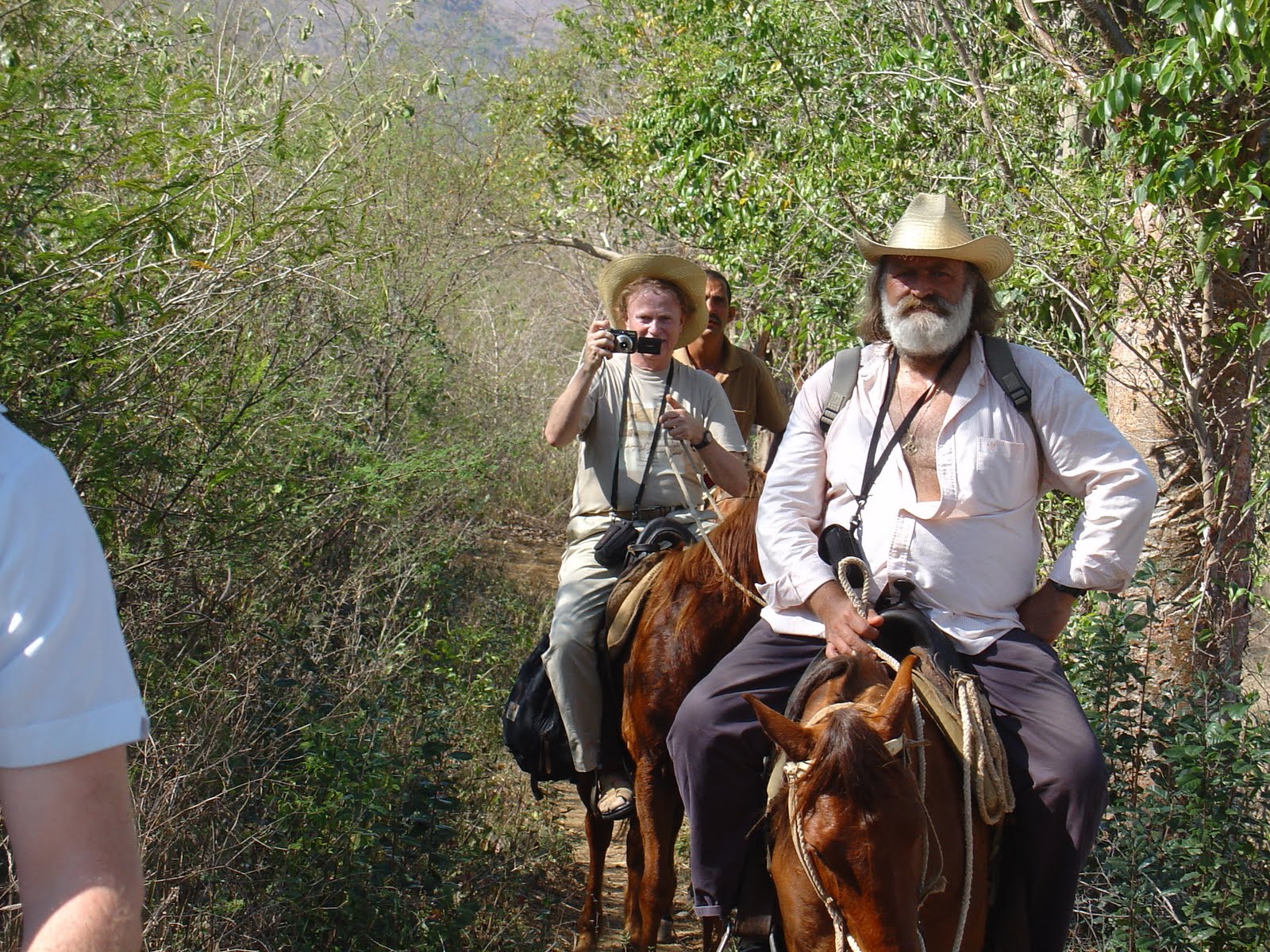
On a peaceful Saturday morning - sorting my hard disk, I came across a snippet of Video I made in 2007. 5 intrepid travelling boys intent on discovering Cuba. One day we rented a horse each and set out into the back country. There were no roads; hence no cars. We felt like real compesinos.
After a long ride, we arrived at a farm, and met a delightful bunch of genuine campesinos. This is what welcomed us:
Safely back in beautiful Trinidad - a UNESCO World Heritage site, we relaxed with good local food and music.
And in Cuba, you cannot avoid coming across some beautiful women. The rumours are true!
But - boys will be boys, and here is the experience the really blew us away! Right in the middle of a remote country road, we came across some guys with a steam train, and they wasted no time inviting us on board. Some of us got really excited! See for yourself!
There could be much more to tell, but life is too short. :-)
After a long ride, we arrived at a farm, and met a delightful bunch of genuine campesinos. This is what welcomed us:
Safely back in beautiful Trinidad - a UNESCO World Heritage site, we relaxed with good local food and music.
And in Cuba, you cannot avoid coming across some beautiful women. The rumours are true!
But - boys will be boys, and here is the experience the really blew us away! Right in the middle of a remote country road, we came across some guys with a steam train, and they wasted no time inviting us on board. Some of us got really excited! See for yourself!
There could be much more to tell, but life is too short. :-)
Thursday, 14 April 2011
Accelerating! The Serial Hybrid with in-wheel electric motors
My dream car is a radical departure from what we have today. Well not quite.. It will have four wheels. But they will be different. This picture hints at it:
Research into these motors is advancing nicely. Here is an exploded view of one version:
Why not have the kinetic energy produced right where it is needed? In the wheel itself! Several companies are now researching in-wheel motors. The next item for discussion is the battery. Tesla already has one with a range of 300 + kilometers. But I want 1,000 +.
Research into these motors is advancing nicely. Here is an exploded view of one version:
Why not have the kinetic energy produced right where it is needed? In the wheel itself! Several companies are now researching in-wheel motors. The next item for discussion is the battery. Tesla already has one with a range of 300 + kilometers. But I want 1,000 +.
Advances in battery technology have not stopped. Check this quote from some research going on at Stanford University:
In this project, researchers Stanford University will seek to develop an "All-Electron Battery", a completely new class of electrical energy storage devices for electric vehicles that has the potential to provide ultra-high energy and power densities, while enabling extremely high cycle life. The All-Electron Battery stores energy by moving electrons, rather than ions, and uses electron/hole redox instead of capacitive polarization of a double-layer. This technology uses a novel architecture that has potential for very high energy density because it decouples the two functions of capacitors: charge separation and breakdown strength. If successful, this project will develop a completely new paradigm in energy storage for electrified vehicles that could revolutionize the electric vehicle industry and establish U.S. leadership in advanced energy storage technology for electric vehicles.
But there is more! Have you heard about the Wave Disk Generator? It is a completely new engine concept and looks a bit like this:
And here is a schematic of how it works:
This combustion engine will reduce emissions by 90% compared to conventional internal combustion engines. It will be perfect for recharging the batteries in your future electric car. With a 50 liter tank this serial hybrid concept will probably give you a range of 2,000km on one tank.
This dream of a combo will not hit your stores quite yet. But when it does, cars will become cheaper to build, cheaper to run and will become the darlings of Mother Earth!
Saturday, 19 March 2011
Identity - Security - Privacy
Perhaps we are not fully conscious of the transformation that has taken place from a very physical world where our interactions were direct and tactile. Speaking, catching the train to visit friends, sending a letter through the post and so on.
Not very long ago, this started to change. Today, there is still only one physical implementation of me, but I have spawned hundreds of virtual replicas, avatars, aliases, proxies, whatever. Do I control these? No, absolutely not. Even my own government is sloppy in the extreme in protecting my virtual integrity. The Norwegian Parliament is in animated discussions about the Data Storage Directive. In fact, they are conducting entirely the wrong debate.
Whilst there is clearly a need to ensure that my privacy and integrity is protected, we do need countermeasures against cynical, asocial persons who exploit vulnerable children, build drug empires that are becoming bigger than the legal economy, and misguided fanatics who believe tearing innocent civilians to shreds brings salvation.
Some simple principles may help the debate. Since there is just one of me, I need to establish a biometric connection between me and my virtual alter ego; my cyber-me. If I can fully control and manage my cyber-me, then I can permit others to access it for agreed purposes. I can opt them in to my cyber world. My government will have certain rights, but since in a democratic society I am the Master and the government and civil service just that - servants, I can require them to conform to certain rules of the game.
If the way in which I allow my cyber-me to be used is called a context, then one such could be my tax affairs, another my dealings with the social services and so on. On another plane, I could permit Amazon, eBay, Facebook or others to access my cyber-me in an agreed fashion.
Many-to-many relationships are doomed to über-complexity and potential failure. One-to-many is a good start. Since there is just one of each of us, perhaps that is the best point of departure. So, in order to build a sound identity infrastructure, say in Norway, let us start by creating an unbreakable bond between me and my cyber-me - a biometric bond. After that we can start having some fun with organisational and technical architecture!
Not very long ago, this started to change. Today, there is still only one physical implementation of me, but I have spawned hundreds of virtual replicas, avatars, aliases, proxies, whatever. Do I control these? No, absolutely not. Even my own government is sloppy in the extreme in protecting my virtual integrity. The Norwegian Parliament is in animated discussions about the Data Storage Directive. In fact, they are conducting entirely the wrong debate.
Whilst there is clearly a need to ensure that my privacy and integrity is protected, we do need countermeasures against cynical, asocial persons who exploit vulnerable children, build drug empires that are becoming bigger than the legal economy, and misguided fanatics who believe tearing innocent civilians to shreds brings salvation.
Some simple principles may help the debate. Since there is just one of me, I need to establish a biometric connection between me and my virtual alter ego; my cyber-me. If I can fully control and manage my cyber-me, then I can permit others to access it for agreed purposes. I can opt them in to my cyber world. My government will have certain rights, but since in a democratic society I am the Master and the government and civil service just that - servants, I can require them to conform to certain rules of the game.
If the way in which I allow my cyber-me to be used is called a context, then one such could be my tax affairs, another my dealings with the social services and so on. On another plane, I could permit Amazon, eBay, Facebook or others to access my cyber-me in an agreed fashion.
Many-to-many relationships are doomed to über-complexity and potential failure. One-to-many is a good start. Since there is just one of each of us, perhaps that is the best point of departure. So, in order to build a sound identity infrastructure, say in Norway, let us start by creating an unbreakable bond between me and my cyber-me - a biometric bond. After that we can start having some fun with organisational and technical architecture!
Wednesday, 16 March 2011
Are we in for a new radiation disaster?
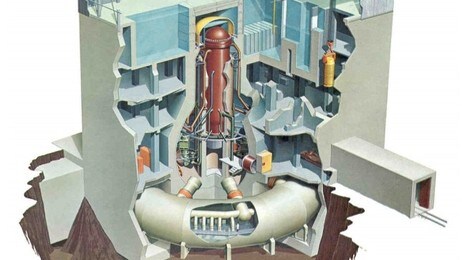
If one of these:
Ends up breaking apart and this is the result:
We have yet another reminder that we must see what clean renewable energy can do for us.
Perhaps Geothermal should be looked at more seriously?
Watch this space!!
Thursday, 17 February 2011
Turning smelly organic waste into hydrogen and organic fertilizer
There are thousands of municipal waste dumps using anaerobic digestion to produce bio-gas from organic waste. This can be used for road transport, electricity generation or heating. However, the sludge that is left over represents a major challenge in terms of disposal and cost.
A new process is now emerging that will convert the bio-gas to hydrogen and have carbon as a byproduct. In addition, the process will dry the sludge and add carbon to it, resulting in bagged, dry organic fertilizer laced with carbon particles. These have the ability to neutralize harmful chemicals and metals.The Vortair sludge processing system makes it possible to turn the sludge into a dry powder which can be stored, transported and traded at commercial terms.
The process converts sewage and biogas sludge into a fine dry powder in a matter of seconds, removing 98% of the contained water. The low pressure vortex ‘shakes’ the water from the input feed material and creates multiple hotspots resulting in a drying mechanism that is a mix of thermal and mechanical processes. Energy savings over conventional thermal drying are considerable, making it economically viable where conventional drying would not be.
The company behind this is Agroplas, a Norwegian company. (www.agroplas.no). It holds the promise of turning waste into profitable products whilst making it carbon negative.
This is a dream example of how the threat posed by global warming has stimulated inventive minds to find a solution that demonstrates that we can turn a problem into an opportunity.
Saturday, 13 February 2010
Value
The word VALUE is very interesting. Think about it. Is it not the essence of everything? It has many flavours. Financial. Artistic. Aesthetic. Social. Spiritual.
It can be destroyed - degraded - augmented - preserved - incremented.
Our attitude and behaviour in relation to it determines the human condition.
The cumulative effects of human behaviour on everything is yet another aspect of globalization. Think about that too.
It can be destroyed - degraded - augmented - preserved - incremented.
Our attitude and behaviour in relation to it determines the human condition.
The cumulative effects of human behaviour on everything is yet another aspect of globalization. Think about that too.
Friday, 12 February 2010
The Norwegian Climate Scene
Apologies to anyone unable to decipher the Norwegian code, but the attached link is a very useful summary of the debate and activities on the Norwegian front:
http://www.rorg.no/Artikler/2126.html
Subscribe to:
Posts (Atom)